

Bought a Car With No V5C Logbook? Here's What to Do

Table of Contents
Buying a car without a V5C logbook is more common than it should be and more risky than many buyers realise. The V5C is the cornerstone document for vehicle registration in the UK, and its absence can create serious complications when it comes to taxing the vehicle, selling it on, or proving you're the legitimate keeper. This guide explains exactly what to do if you find yourself in this situation, whether you've already bought or you're still deciding.
Ready to Submit Your V62 Form?
Complete your application online in 5 minutes. We handle everything from printing to DVLA submission.
Start Your Application →Is It Legal to Buy a Car Without a V5C?
Technically, yes it is legal to purchase a vehicle that doesn't come with a V5C logbook. There is no law that requires the document to change hands at the point of sale. However, buying without one creates significant risk for the buyer. Without a V5C, you cannot easily prove who the registered keeper is, and you may encounter problems taxing the car, insuring it, or selling it in future.
The bigger concern is what the absence of a logbook might indicate. In some cases, it simply means the seller has misplaced the document. In other cases, it can be a warning sign of a more serious problem, such as the vehicle having been stolen, written off, or fraudulently sold with a cloned identity.
⚠️ Important warning
Before completing any private car purchase without a V5C, always run a vehicle history check using a service like HPI Check or the DVLA's free online vehicle enquiry tool. This can reveal if the car is stolen, scrapped, or has outstanding finance.
Red Flags to Watch For
A seller who cannot produce a V5C is not automatically dishonest, but there are additional warning signs that should make you walk away. If the seller is reluctant to let you inspect the VIN plate on the vehicle, or if the VIN doesn't match the number visible through the windscreen, this is a serious concern. Similarly, a seller who insists on meeting in a public car park rather than their home address or who can't provide proof that the address matches the DVLA's records should be treated with caution.
If the price seems significantly below market value for the age and condition of the vehicle, factor in the risk. Stolen vehicles and write-offs can appear physically intact but come with enormous hidden problems, including the possibility of the vehicle being reclaimed or declared unroadworthy.

What to Do If You've Already Bought
If you've already purchased the vehicle and realise there's no logbook, your first step is to contact the seller and ask them to apply for a duplicate V5C or to formally notify the DVLA of the change of keeper. If they're cooperative and still in contact, this is the cleanest resolution. The seller can complete the keeper change online through the DVLA, after which a V5C will be issued in your name automatically.
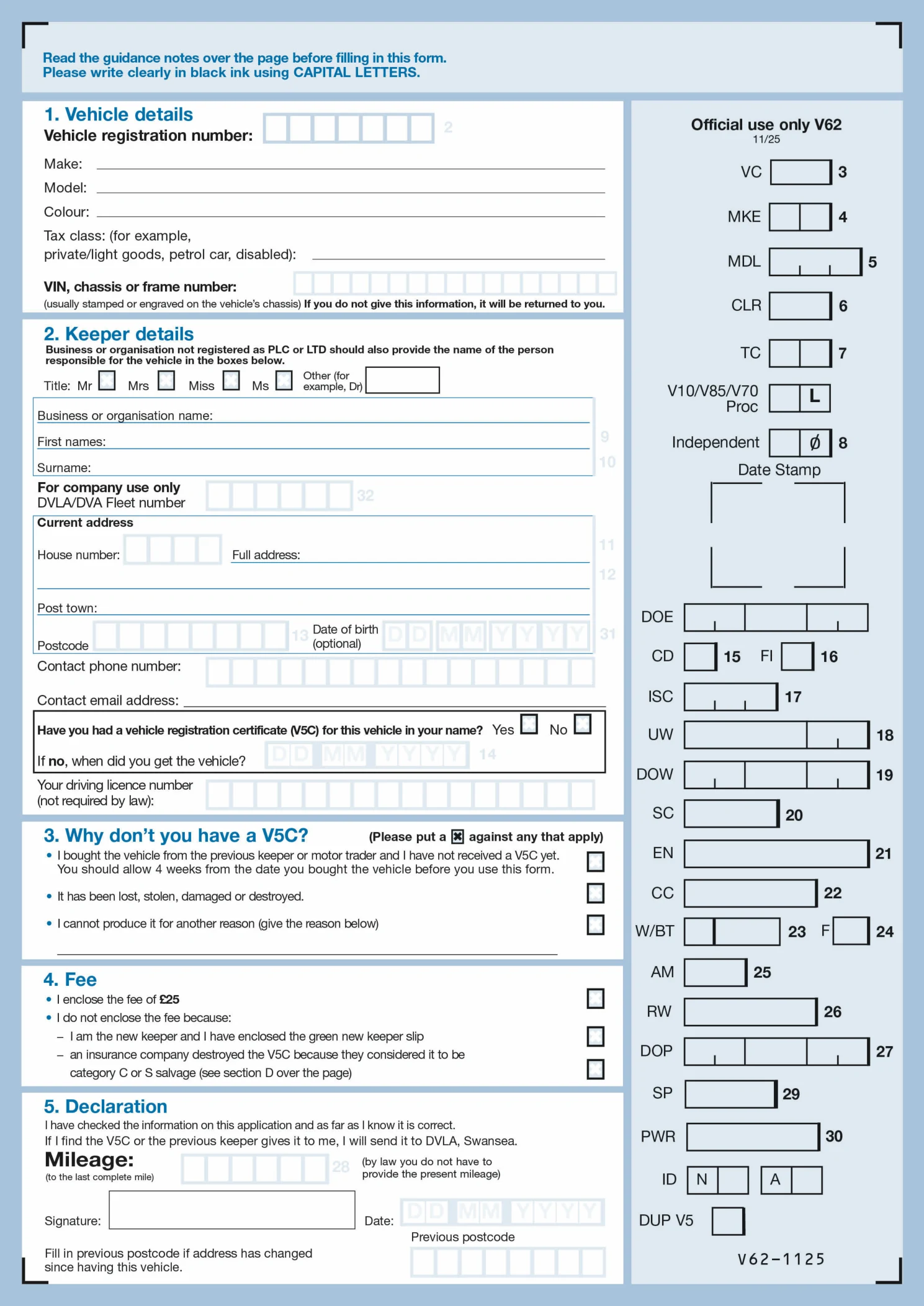
If the seller is uncontactable or uncooperative, you will need to apply yourself using the V62 form. The V62 allows a new or prospective keeper to apply directly for a V5C, even without having the original document. You'll need to provide the vehicle's registration number, make, model, VIN, and your own details as the new registered keeper.
| Situation | Best Course of Action |
|---|---|
| Seller still contactable | Ask seller to notify DVLA of keeper change |
| Seller has green V5C/2 slip | Submit V62 with the slip for faster processing |
| No paperwork at all | Submit V62 with all vehicle details you have |
| Vehicle may be stolen/cloned | Report to police before doing anything else |
Applying for a V5C With a V62 Form
The V62 form is the DVLA's standard application for a replacement vehicle registration certificate. As a new keeper without a V5C, you are entitled to apply using this form. You'll need the vehicle's registration mark, make, model, year of first registration, engine size, and VIN/chassis number. All of this information should be visible on the vehicle itself. The VIN is typically stamped into the bulkhead in the engine bay or on a plate visible through the windscreen.
Of course, Car Forms can do this for you:
Ready to Submit Your V62 Form?
Complete your application online in 5 minutes. We handle everything from printing to DVLA submission.
Start Your Application →The completed V62 must be sent to the DVLA in Swansea along with a £25 payment. If you have the green V5C/2 new keeper slip from the seller, include it with your application the DVLA specifically requests this where available. Once received, the DVLA will cross-reference your details with their records and issue a V5C to your address, typically within two to six weeks.
Can You Drive Without a Logbook?
Yes, you are not legally required to carry the V5C in the vehicle while driving. The document is for registration and administrative purposes, not a roadside requirement. As long as the vehicle is taxed, insured, and holds a valid MOT, you can legally drive it while waiting for a replacement V5C to be issued.
However, be aware that insurance companies may ask for the V5C when you set up a policy, and some insurers will want to verify it matches the vehicle details. Most will allow you to insure the car while the logbook is being reissued, provided you can supply other proof of purchase and vehicle identity.
How to Protect Yourself in Future
When buying any used vehicle privately, always insist on seeing the V5C before exchanging money. Check that the seller's name and address on the logbook matches their ID and the address where you're viewing the car. If they claim the logbook is "in the post" or "being transferred," treat this as a red flag and either wait until it arrives or walk away from the deal.
Using the DVLA's free online vehicle enquiry service takes less than a minute and will immediately flag if a vehicle is marked as scrapped or if there's a mismatch in the recorded details. A paid HPI check is also worth considering as it's far cheaper than discovering a problem after the fact.
Frequently Asked Questions
Is it legal to buy a car without a V5C? +
Yes, it is not illegal to buy or sell a car without a V5C. However, it creates significant practical and legal risk for the buyer. Without a logbook, proving you are the registered keeper, taxing the vehicle, or selling it on becomes much harder.
What should I do if I bought a car with no logbook? +
First, ask the seller to notify the DVLA of the keeper change. If they are uncooperative or unreachable, apply for a replacement V5C yourself using a V62 form. You will need the vehicle registration number, make, model, and VIN. CarForms.co.uk can handle this for you online.
Can I drive a car I bought without a V5C? +
Yes. There is no legal requirement to carry the V5C in the vehicle. As long as the car is taxed, insured, and has a valid MOT, you can drive it while waiting for a replacement logbook to arrive.
How do I apply for a V5C when I have no paperwork at all? +
Complete a V62 form with all the vehicle details you can gather from the car itself, including the number plate, make, model, and VIN stamped on the vehicle. Send it with the £25 DVLA fee to DVLA, Swansea, SA99 1AR. If you have the green V5C/2 new keeper slip, include it.
What if the car might be stolen? +
Report it to the police immediately before taking any further steps. Do not drive the vehicle or submit a V62 until you have confirmed it is not on the stolen vehicle register. You can check free of charge using the DVLA's online vehicle enquiry service.
Sources
The information in this article is based on official DVLA guidance and UK government publications.
Comments (1)
I wasn't sure about the legality part. This cleared it up.